 blog
7 Ways to Reduce Custom Metal Fabrication Costs
Table of Contents
- Optimize Part Geometry and Reduce Complexity
- Design for Manufacturability to Lower Production Time
- Choose Cost-Effective Materials and Standard Sheet Sizes
- Maximize Material Yield Through Smart Nesting and Offcut Reuse
- Select the Right Cutting and Fabrication Processes
- Understanding Metal Fabrication Pricing and Getting Accurate Quotes
- Plan Production Volume and Batch Sizes for Better Metal Fabrication Quote Outcomes
- Frequently Asked Questions
Last Updated: October 12, 2026
Optimize Part Geometry and Reduce Complexity
Among the 7 ways to reduce custom metal fabrication costs, the easiest is to simplify your design. Every complex curve, tight angle, and intricate feature adds time and expense.
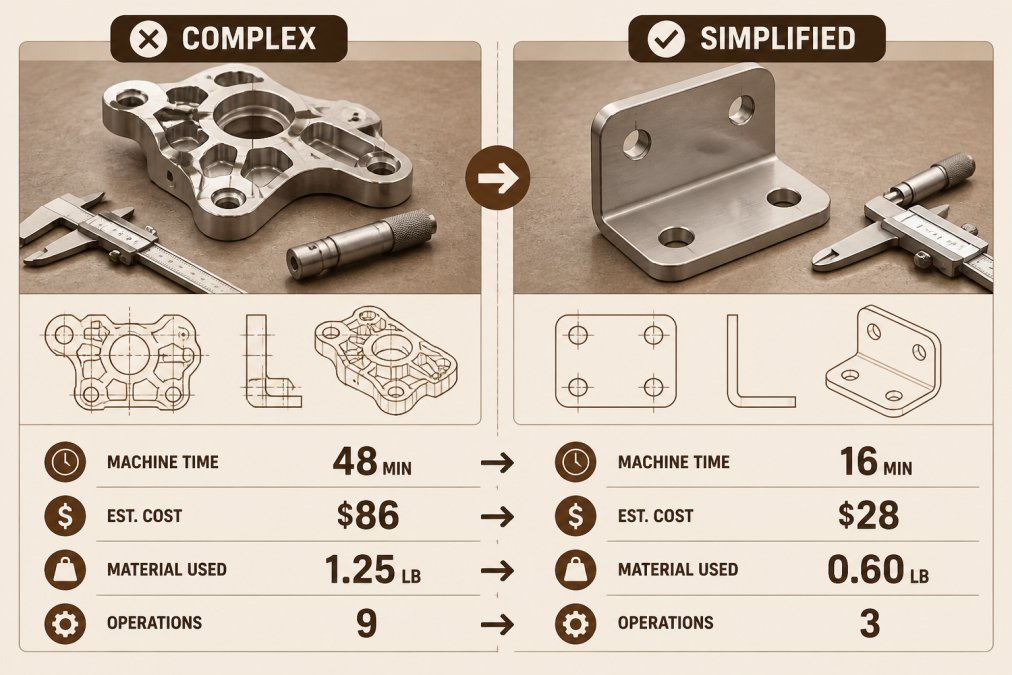
Review your geometry critically: does each feature serve a function, or is it decorative? Many designers add complexity out of habit, not necessity.
Here's what simplification looks like in practice:
- Replace complex curves with straight lines or standard radii
- Eliminate unnecessary holes, slots, or cutouts
- Use flat surfaces instead of contoured ones
- Reduce the number of bends in sheet metal designs
Reducing complexity lowers setup time, less programming and tool adjustment, and that savings hits your invoice.
Design for Manufacturability to Lower Production Time
Design for manufacturability (DFM) means building your part with the fabrication process in mind. Fewer steps mean less labor and lower costs.
Start with these principles:
- Use standard hole sizes. Custom hole sizes require custom tooling. Stick with common diameters like 1/4", 3/8", and 1/2".
- Apply uniform wall thickness. Varying thickness creates weak spots and complicates fabrication. Aim for consistent material depth throughout.
- Design for your chosen process. If you're using laser cutting, avoid tiny details. If you're bending sheet metal, follow the bend radius limits of your material.
- Minimize the number of operations. Each operation, cutting, bending, welding, finishing, adds cost. Consolidate where possible.
Share your design with your fabricator before committing. Their experience can suggest modifications that keep your intent while cutting production time.
Choose Cost-Effective Materials and Standard Sheet Sizes
Material, thickness, and stock size all drive your final price. Many projects specify premium materials out of caution, not necessity, if your application doesn't demand stainless steel, carbon steel costs less and performs just as well.
Common standard sheet sizes include:
- 36" × 96"
- 48" × 96"
- 48" × 120"
- 60" × 120"
If your parts fit neatly into one of these sizes, your fabricator can nest multiple parts on a single sheet, improving material yield and lowering per-part cost.
Maximize Material Yield Through Smart Nesting and Offcut Reuse
Material waste is money wasted. Nesting layout, how parts are arranged on a sheet before cutting, can reduce scrap by 10-15% versus a careless layout, and that compounds across large runs.
Here's how to optimize nesting:
- Group similar-sized parts together. They cut more efficiently and leave fewer awkward remnants.
- Rotate parts to minimize waste. A part rotated 45 degrees might fit into a gap that a straight orientation leaves empty.
- Leave room for kerf. The laser or plasma torch removes material as it cuts. Account for this in your layout.
- Communicate part priority. If some parts are more critical than others, tell your fabricator. They'll prioritize those and nest scrap-prone parts around them.
Consider reusing offcuts too. Some shops maintain a scrap bin for customers who let remnants be repurposed, it requires tracking, but for high-volume work it can meaningfully cut material costs.
Select the Right Cutting and Fabrication Processes
Different processes suit different jobs, and the choice affects quality and cost.
The three cost drivers behind every process decision
Every cutting and forming method trades off three things:
- Setup cost, programming, tooling, fixturing, and machine calibration before the first good part comes off the machine.
- Per-part cost, cycle time, consumables (nozzles, electrodes, shielding gas, abrasives), and labor per unit.
- Capability cost, the precision, edge quality, and material range the process can deliver. You pay for capability you may not need.
High setup with low per-part cost wins on volume; low setup with high per-part cost wins on one-offs. Break-even is usually driven by setup, not cutting speed.
Cutting methods: when each one actually pays off
- Laser cutting (fiber). Fast, precise, minimal heat-affected zone. Best for thin to medium sheet, commonly up to about 1/4" in mild steel, thicker on higher-power machines. High equipment cost makes it economical only when volume amortizes programming and fixturing.
- Plasma cutting. Good for thicker materials and faster than laser on heavy stock, but rougher edges and a larger heat-affected zone mean secondary operations on mating surfaces. Economical when thickness or budget rules out laser.
- Shearing. Straight cuts only, no heat, no distortion. The cheapest option for simple straight cuts on thicker material. Useless for profiles, holes, or curves, but if your part is a rectangle, shearing beats every thermal process on cost.
- Punching (turret or single-station). Repeats the same hole or shape rapidly. Setup cost is high because it requires a die, but per-part cost is very low at volume. The classic high-volume, low-mix choice.
Forming and bending
- Press brake. The workhorse for sheet metal bending. Standard tooling and radii cost less; custom tooling adds charges. Air bending is cheaper than bottoming or coining, less tonnage, simpler tooling.
- Roll forming. Creates long, consistent curves and complex profiles. Setup is expensive, so it only makes sense at high volume where tooling cost is spread across thousands of feet.
- Hand bending. Flexible and tooling-light, but labor-intensive. Best for low-volume or one-off work where setup cost would dominate.
Welding and joining
- MIG welding. Fast, clean, good for production. Standard joint designs cost less because they need less fit-up and rework.
- TIG welding. High precision and aesthetic quality. More time-intensive, so higher labor cost per inch of weld. Justified when appearance or code requirements demand it.
- Spot welding. Rapid for assembly, but requires custom tooling for each design. Pays off at volume.
How to actually choose
Ask your fabricator three questions before locking in a process:
- What is the total cost at my quantity, not just the per-part rate? A lower per-part rate can still lose if setup is higher and volume is low.
- What capability do I actually need? If a plasma-cut edge is acceptable for a non-mating surface, paying for laser precision is waste. If a tolerance is noncritical, say so, relaxing it can open up cheaper processes.
- What secondary operations does this process trigger? A cheap cut that needs deburring, straightening, or edge cleanup may cost more than a pricier cut that comes off the machine ready to use.
Understanding Metal Fabrication Pricing and Getting Accurate Quotes
"Get multiple quotes" is worthless if the quotes aren't comparable. Here's how a fabrication quote is built and how to compare on equal footing.
How a fabrication quote is actually built
A quote is a stack of cost layers. Understanding them shows where your money goes and where you can push back.
- Material cost. Raw stock plus waste, driven by nesting yield and whether you specified a standard sheet size or custom cut.
- Setup cost. Programming, tooling, fixturing, calibration. Fixed per job, so it dominates low-volume pricing.
- Production cost. Cycle time per part times quantity, plus consumables and direct labor.
- Secondary operations. Deburring, tapping, countersinking, straightening, post-cut cleanup.
A worked example of how the layers interact
Consider a simple bracket, roughly 6" × 4", cut from 1/8" mild steel, with two bends and a powder-coat finish.
- At 5 units: setup (programming, tooling, first-article check) is spread across only five parts, so it can easily be the largest single line. Per-part cost is high.
- At 50 units: the same setup is spread across ten times as many parts, so setup per part drops sharply and material and production dominate.
- At 500 units: setup per part is nearly negligible. Material yield, cycle time, and finishing drive the price, and a small nesting improvement or cheaper finish moves the total most.
The lesson: the same part has a different cost structure at each quantity. At low volume, attack setup; at high volume, attack material yield and cycle time.
A quote-comparison checklist
Before comparing two quotes, confirm they match on every line below. If they don't, you're comparing different scopes, not prices.
- Material grade and specification. Carbon steel, stainless, aluminum, or alloy, and the exact grade. "Steel" is not a specification.
- Thickness and tolerance. Confirm the gauge or plate thickness and the dimensional tolerance the shop is quoting to.
- Quantity and unit of measure. Per part, per set, or per order. Confirm whether the price includes overruns or underruns.
- Cutting and forming process. Laser, plasma, waterjet, shear, punch, and the bend method. Different processes at the same price are not the same quote.
What to send with a quote request
Vague requests produce inflated quotes because fabricators add contingency when unsure. Send:
- Detailed drawings with dimensions and tolerances, noting which are critical.
- Material specification and required thickness.
- Quantity and delivery timeline.
- Special finishing, testing, or certification requirements.
- Whether you need prototypes, first articles, or production tooling.
Reading a quote for red flags
A quote dramatically lower than the others isn't automatically a bargain. Look for what it omits: missing finishing scope, unspecified material grade, no inspection line, or a lead time that assumes material is already on the floor. A dramatically higher quote may be pricing in risk it lacks the information to eliminate.
Plan Production Volume and Batch Sizes for Better Metal Fabrication Quote Outcomes
Production volume dramatically affects per-unit cost.
Here's how volume affects your options:
- Low volume (1-10 units). Manual processes, minimal tooling. Higher per-unit cost but low upfront investment.
- Medium volume (10-100 units). Some custom tooling justified. Faster processes become economical.
- High volume (100+ units). Full automation, custom fixtures, dedicated tooling. Per-unit cost drops significantly.
Plan batch sizes strategically: if you need 50 parts across five orders, ask whether ordering all 50 at once lowers the per-unit price, it usually does, saving setup and nesting time.
At Patriot Iron Work, we help clients navigate these decisions every day. Our team brings professional craftsmanship and a focus on efficiency to every project, identifying cost-saving opportunities without compromising quality or safety.
Frequently Asked Questions
What are the main factors that drive up custom metal fabrication costs?
Custom metal fabrication costs depend on material selection, part complexity, production volume, and the processes required. Complex geometries with tight tolerances, small batch sizes, and premium materials increase expenses. Tooling setup, labor time, and scrap generation also contribute significantly. By optimizing design, using standard sheet sizes, and planning production runs strategically, you can reduce these cost drivers substantially.
How can design changes reduce sheet metal fabrication costs?
Design simplification is one of the most effective ways to lower costs. Eliminate unnecessary features, use standard bend radii, avoid complex internal geometry, and design parts that nest efficiently. Standardizing hole sizes, reducing the number of operations, and using flat patterns that minimize material waste all reduce both setup time and scrap generation. Working with your fabricator during the design phase ensures your CAD files are optimized for their equipment and processes.
Does ordering larger quantities reduce metal fabrication pricing?
Yes, larger production volumes typically lower per-unit costs. Bulk orders spread setup time, tooling costs, and labor across more parts, reducing the cost per piece. However, the savings depend on your supplier's capacity and your storage needs. Getting a detailed metal fabrication quote that breaks down per-unit pricing at different batch sizes helps you determine the optimal order quantity for your budget and project timeline.
How can I compare supplier quotes fairly and ensure I'm getting the best value?
Request quotes from multiple fabricators using identical technical drawings and specifications. Ensure each quote breaks down material costs, labor, tooling, finishing, and delivery separately. Compare lead times, quality certifications, and warranty terms alongside price. Ask how each supplier would optimize your design for their processes. The lowest price isn't always the best value; a slightly higher quote from a reliable partner with faster turnaround or better quality control often saves money overall through fewer delays and rework.