 How-to
How to Calculate Structural Steel Erection Costs
Table of Contents
- Understanding Structural Steel Erection Costs
- Step 1: Determine Your Material Takeoff and Steel Grade
- Step 2: Calculate the Structural Steel Cost Breakdown
- Step 3: Estimate Steel Erection Labor Cost Using a Labor Cost Estimator
- Step 4: Factor in Structural Steel Installation Cost Factors
- Step 5: Calculate Cost Per Pound and Unit Pricing
- Step 6: Build Your Complete Cost Estimate Worksheet
- Worked Example: Estimating a Small Commercial Building
- Frequently Asked Questions
Last Updated: October 5, 2026
Understanding Structural Steel Erection Costs
Calculating structural steel erection costs requires breaking down material, fabrication, labor, equipment, and overhead.
The total cost of structural steel erection typically includes four categories: steel material and supply; fabrication and painting; transportation and delivery; and labor and equipment for on-site erection.
Understanding how these pieces fit together prevents budget surprises. This guide walks you through each step so you can build a defensible cost estimate from the ground up.
Step 1: Determine Your Material Takeoff and Steel Grade
Your first task is creating a material takeoff ("takeoff" or "MTO") listing every piece of steel by weight, piece count, and grade.
Start by reviewing the structural drawings and specifications. Identify:
- Total steel tonnage needed
- Individual member sizes (beams, columns, bracing)
- Steel grades specified (ASTM A36, A572, A992, etc.)
- Bolt and connection requirements
Steel grade affects cost: higher-strength grades like A572 Grade 50 cost more than A36, and specialty grades for weathering or seismic resistance add premiums.
Piece count matters too. A project with 50 large members erects faster than one with 500 small pieces, since more pieces mean more handling, connections, and labor hours.
Step 2: Calculate the Structural Steel Cost Breakdown
Once you have your material takeoff, you need pricing for each component. This section breaks down the major cost categories.
Steel Supply and Material Costs
Steel material cost depends on current market prices, which fluctuate regularly. Pricing typically reflects:
- Base price per pound or ton of raw steel
- Mill surcharges for specialty grades or small quantities
- Supplier markup and profit
- Order timing and delivery urgency
Contact your steel supplier with your takeoff showing tonnage and grades; they quote per-pound or per-ton rates. A small fabrication shop may pay more per pound than a large general contractor because they order less volume.
Order size affects price. Ordering 100 tons in one shipment costs less per pound than ordering 20 tons. Timing also matters. Rush orders carry premiums. Seasonal demand peaks in spring and summer, pushing prices up.
Fabrication and Painting Costs
Fabrication transforms raw steel into finished members ready for erection.
Fabrication pricing depends on complexity. Simple bolted connections cost less than welded details. Members with many holes take longer to punch.
Painting adds cost. Shop primer is standard, while full multi-coat paint systems and corrosion-resistant coatings for exposed or weathering steel cost more.
Fabricators quote based on labor hours, equipment time, and material waste, either per-ton or per-member.
Delivery and Transportation
Steel moves from mill to fabricator to job site.
Distance drives transportation cost: a local project costs less to haul than one 500 miles away.
Oversized or heavy members may require special hauling permits, escorts, and trailers for lengths exceeding standard truck beds, all of which add cost.
Delivery timing matters. Rush delivery costs more. Coordinating delivery with your erection schedule prevents storage costs and job site congestion.
Step 3: Estimate Steel Erection Labor Cost Using a Labor Cost Estimator
Steel erection labor is often the largest cost component. Estimating erection labor requires understanding labor hours and productivity rates.
Labor Hours and Productivity Rates
Productivity depends on:
- Member size and weight (larger pieces erect faster per ton)
- Connection type (bolted vs. welded, simple vs. complex)
- Crew size and experience
- Crane availability and efficiency
A crew erecting large beams on a simple frame moves fast; one installing small bracing members with welded connections moves slower.
Estimate labor hours by multiplying total tonnage by the expected productivity rate: 200 tons at 6 hours per ton equals 1,200 labor hours.
Labor cost equals hours multiplied by the hourly wage. Wages vary by region and union status.
Site Conditions and Project Complexity
Site conditions dramatically affect labor productivity. Easy conditions speed up the work. Difficult conditions slow it down.
Favorable conditions:
- Level, well-prepared site
- Good access for trucks and cranes
- Clear weather
- Adequate staging area
Difficult conditions:
- Tight site with limited crane access
- Poor ground conditions requiring special equipment
- Weather delays (rain, snow, extreme heat or cold)
- Complex geometry or many different member sizes
Estimate how these conditions affect your productivity rate. A tight urban site may reduce productivity by 25 percent. Extensive welding may add 30 percent. Account for these factors in your labor estimate.
Step 4: Factor in Structural Steel Installation Cost Factors
Beyond direct labor, erection requires equipment and overhead, significant indirect costs.
Equipment and Crane Costs
Cranes are essential for steel erection. Crane cost depends on type, size, and duration.
Common crane types:
- Mobile cranes (rented by the day or week)
- Tower cranes (rented by the month, often for longer projects)
- Crawler cranes (for heavy lifts or difficult access)
Crane pricing includes:
- Equipment rental
- Operator wages
- Fuel and maintenance
- Setup and dismantling
A mobile crane may cost $2,000 to $5,000 per day. A tower crane on a multi-month project may cost $10,000 to $20,000 per month. Larger cranes cost more.
Estimate crane time by dividing total tonnage by the crane's lift rate. A 50-ton mobile crane lifting 10-ton pieces at 8 lifts per hour erects 80 tons in a day, so a 200-ton project takes roughly 2.5 days of crane time.
Other equipment includes:
- Welding machines and supplies (if site welding is required)
- Temporary bracing and shoring
- Safety equipment and fall protection
- Rigging hardware (slings, shackles, spreader bars)
Mobilization and Overhead
Mobilization covers getting your crew and equipment to the job site and back. Overhead covers supervision, administration, and indirect costs.
Mobilization costs:
- Crew travel and per diem
- Equipment transport
- Initial site setup
- Demobilization at project end
Overhead costs:
- Project manager and supervision
- Safety officer
- Quality control and inspection
- Insurance and bonding
These costs are often calculated as a percentage of direct labor or a flat fee per project: a small project might have 20 percent overhead, a large project 10 percent because overhead is spread across more labor hours.
Step 5: Calculate Cost Per Pound and Unit Pricing
Once you have total costs, calculate unit pricing to validate your estimate against benchmarks.
Cost per pound is total project cost divided by total tonnage converted to pounds: a $400,000 project weighing 200 tons (400,000 pounds) costs $1.00 per pound.
Cost per pound varies by project type and complexity: simple warehouse frames run $0.75 to $1.25 per pound, complex commercial buildings with many connections $1.50 to $2.50, and bridges and specialty structures can exceed $3.00.
Cost per ton is total cost divided by tonnage. A 200-ton project costing $400,000 is $2,000 per ton.
These metrics help you:
- Sanity-check your estimate against similar projects
- Compare bids from different fabricators or erectors
- Track actual costs against estimates
- Identify cost drivers and problem areas
Step 6: Build Your Complete Cost Estimate Worksheet
A structured worksheet organizes all your costs and makes your estimate transparent and defensible.
Create a spreadsheet with these sections:
Direct Costs:
- Steel material (tonnage × cost per pound)
- Fabrication (tonnage × cost per pound or per member)
- Painting (tonnage × cost per pound or per piece)
- Delivery (total freight cost)
- Labor (hours × hourly rate)
Indirect Costs:
- Mobilization (lump sum or percentage of labor)
- Supervision and management (lump sum or percentage)
- Safety and insurance (percentage of labor or lump sum)
- Quality control and testing (lump sum or percentage)
Contingency:
- Risk allowance (typically 5-10 percent of direct costs)
- Escalation (if project spans multiple years)
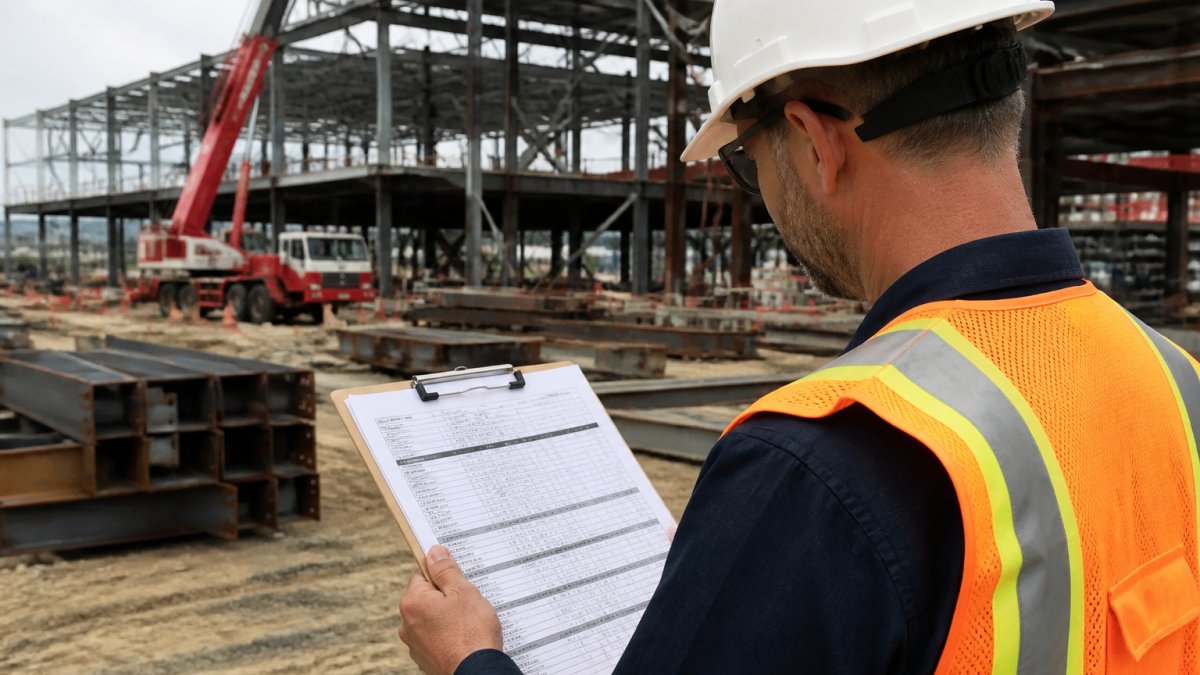
Direct Costs, Indirect Costs, and Contingency
Direct costs vary directly with the work, steel, labor, and equipment, and change if the scope changes.
Indirect costs are overhead and support. Supervision, insurance, and administration happen regardless of whether you erect 100 tons or 200 tons.
Contingency is a reserve for unknowns: worse-than-expected site conditions, rework, and weather delays.
Your total estimate is the sum of all three categories: Direct + Indirect + Contingency = Total Cost.
Validation and Risk Factors
Before submitting your estimate, validate it against benchmarks and identify risks.
Validation steps:
- Calculate cost per pound and compare to similar projects
- Review each line item for reasonableness
- Check labor hours against industry productivity standards
- Confirm supplier and fabricator quotes are current
- Verify crane and equipment costs with rental companies
Risk factors to consider:
- Site access and staging limitations
- Weather exposure and seasonal delays
- Complexity of connections or details
- Availability of skilled labor
- Supply chain delays for materials or equipment
Document your assumptions. State what conditions your estimate assumes. If conditions change, your estimate changes. This protects you and sets clear expectations with your client.
Worked Example: Estimating a Small Commercial Building
Let's walk through a complete estimate for a small office building frame: 150 tons of structural steel, primarily ASTM A992 grade, with bolted connections.
Material Takeoff:
- 150 tons total
- 60 columns (various sizes)
- 120 beams (various sizes)
- Bracing and miscellaneous pieces
Steel Material Cost:
- Current price: $0.55 per pound
- 150 tons = 300,000 pounds
- Material cost: 300,000 × $0.55 = $165,000
Fabrication Cost:
- Complexity: moderate (bolted connections, standard details)
- Rate: $0.35 per pound
- Fabrication cost: 300,000 × $0.35 = $105,000
Painting Cost:
- Shop primer and one-coat paint
- Rate: $0.08 per pound
- Painting cost: 300,000 × $0.08 = $24,000
Delivery Cost:
- Distance: 200 miles
- Freight: $4,500
Labor Cost:
- Productivity: 6 hours per ton (moderate complexity, good site conditions)
- Total hours: 150 × 6 = 900 hours
- Hourly rate: $75 (including wages, benefits, taxes)
- Labor cost: 900 × $75 = $67,500
Crane Cost:
- Mobile crane: 3 days at $3,500 per day
- Crane cost: 3 × $3,500 = $10,500
Mobilization:
- Lump sum: $8,000
Overhead:
- 15 percent of direct labor: $67,500 × 0.15 = $10,125
Contingency:
- 7 percent of direct costs: ($165,000 + $105,000 + $24,000 + $4,500 + $67,500 + $10,500) × 0.07 = $26,460
Total Estimate:
- Direct costs: $376,500
- Indirect costs: $10,125
- Contingency: $26,460
- Total: $413,085
Unit Pricing Check:
- Cost per pound: $413,085 ÷ 300,000 = $1.38 per pound
- Cost per ton: $413,085 ÷ 150 = $2,754 per ton
These unit prices fall within typical ranges for a moderately complex commercial building with bolted connections. The estimate is reasonable and defensible.
Calculating structural steel erection costs demands attention to detail and understanding of the major cost drivers.
Frequently Asked Questions
What is the average cost of structural steel per pound?
Structural steel erection cost per pound varies based on project scope, site conditions, and market conditions. Material costs depend on steel grade and supply availability. Erection labor typically ranges from $10 to $30 per pound depending on complexity, building type, and site access. For an accurate estimate of your specific project, request a quote that factors in your tonnage, timeline, and site conditions.
How do you estimate labor hours for structural steel erection?
Labor hours depend on piece count, tonnage, steel grade, and site conditions. Simple projects with good access may require 4-8 hours per ton, while complex multi-story buildings or tight sites can require 12-20 hours per ton. Start with your material takeoff, apply a productivity rate based on building type and complexity, then adjust for site factors like crane access, weather exposure, and coordination with other trades. Document your assumptions so the estimate can be validated and updated as conditions change.
What costs should be included in a steel erection estimate?
A complete structural steel cost breakdown includes: material supply and fabrication, painting and finishing, delivery and transportation, erection labor, equipment and crane rental, mobilization, insurance, overhead, and contingency. Direct costs cover materials and labor. Indirect costs include supervision, equipment, and site management. Contingency typically ranges from 5-15% depending on project risk and scope clarity. Separating these categories helps identify where costs can be controlled and where risk exists.
How do crane access and site conditions affect steel erection costs?
Site conditions significantly impact structural steel installation cost factors. Poor crane access increases equipment costs and reduces labor productivity, raising erection costs by 20-40%. Tight urban sites, poor soil strata, or limited staging areas require more careful planning and slower work rates. Weather exposure, building height, and coordination with other trades also affect the timeline and resource requirements. Always account for site-specific constraints in your labor productivity assumptions and equipment selections.