 blog
Structural Welding Near Me: 2026 Contractor Guide
Table of Contents
- What to Look for in a Local Structural Welding Contractor
- AWS Certified Structural Welders: Why It Matters for Your Project
- Structural Welding Cost Per Hour: What Drives the Price
- Commercial Steel Fabrication Services for Construction and Industrial Projects
- Safety Compliance and OSHA Standards for Structural Welding
- Maintenance and Inspection Schedules for Structural Welds
- How to Vet a Structural Welding Contractor Near You
- Frequently Asked Questions
Last Updated: September 30, 2026
What to Look for in a Local Structural Welding Contractor
Searching for structural welding near me usually starts the same way: a deadline is close, a beam needs repair, and you need a contractor who can do the work right. Structural welding permanently joins load-bearing steel members so they carry the weight and stress a building or machine demands. Get it wrong, and you face failed inspections, rework, and delays that cost far more than the original job.
Certifications and Code Compliance
Welding certification is documented proof that a welder has passed qualification tests for specific processes and positions. A certified welder has demonstrated, under testing, that their welds meet the required strength and quality standard. Ask which codes they work to and whether they hold current qualifications. The American Welding Society certification programs set the benchmark most commercial projects reference.
On-Site vs. Shop-Based Capabilities
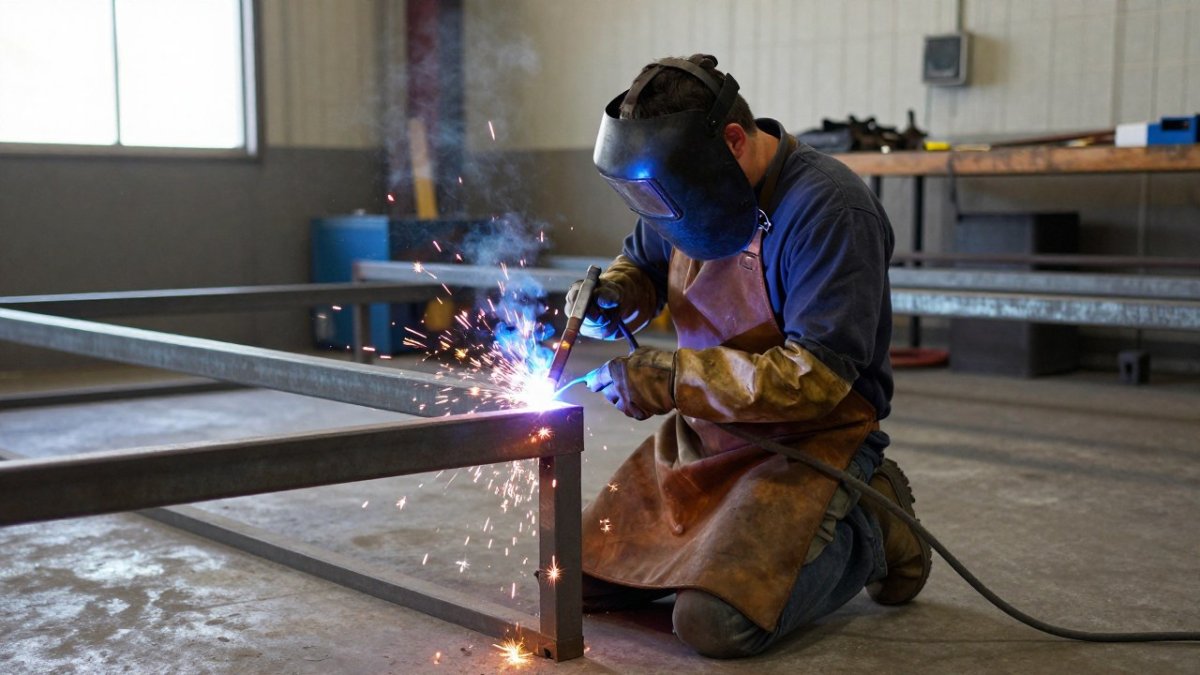
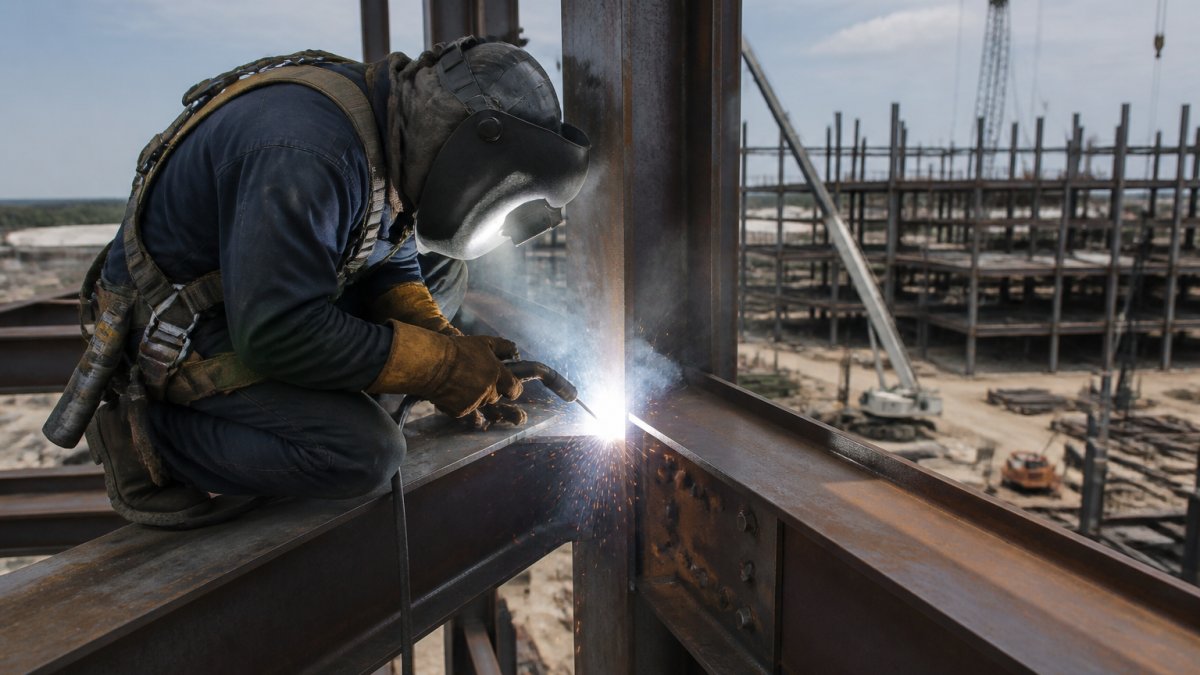
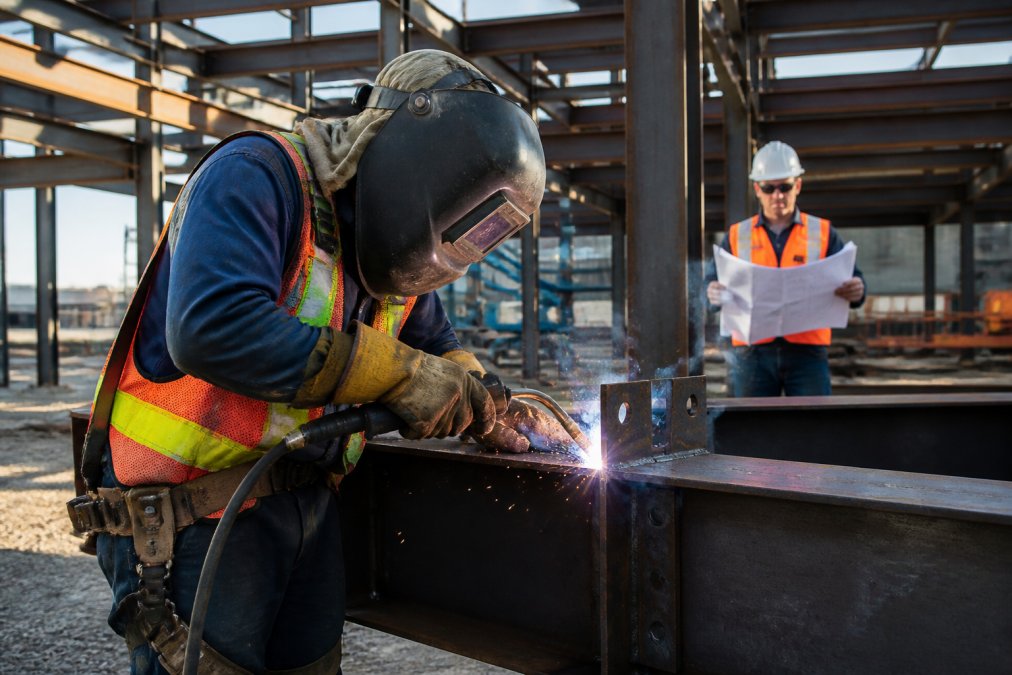
Some jobs belong in a shop. Others have to happen where the steel already stands. On-site welding matters when a member is too large to move, when a repair is urgent, or when field conditions define the work. A shop handles controlled fabrication, jigs, and repeatable quality. The best contractors offer both, so you're not juggling two vendors for one scope.
AWS Certified Structural Welders: Why It Matters for Your Project
AWS certified structural welders hold credentials tied to the American Welding Society, which publishes AWS D1.1/1.1M: Structural Welding Code, Steel, the standard most U.S. commercial and industrial structural steel projects reference. But "AWS certified" on a business card tells you almost nothing about whether a welder is qualified for your joint. The credential only matters when matched to the specific welding procedure your project requires.
The Three Documents That Govern a Structural Weld
Structural welding quality is controlled by a chain of three documents. If any link is missing, the credential is decorative.
- Welding Procedure Specification (WPS), a written, qualified procedure specifying the process, filler metal, joint design, preheat, interpass temperature, current, polarity, and technique for a given weld. It's the recipe.
- Procedure Qualification Record (PQR), the documented test proving the WPS produces sound welds. Under AWS D1.1, a WPS must be supported by a PQR or a prequalified WPS meeting the code's prequalified joint and process conditions.
- Welder Performance Qualification (WPQ), the record showing an individual welder passed a performance test for a specific process, position, and thickness range, proving they can execute the recipe.
What a WPQ Actually Covers
A WPQ is limited in scope. It specifies:
- Process, SMAW, GMAW, FCAW, GTAW, or SAW. Each is a separate qualification.
- Position, flat (1G/1F), horizontal (2G/2F), vertical (3G/3F), overhead (4G/4F), or pipe (5G/6G). A welder qualified in 3G is not automatically qualified in 4G.
- Thickness range, a test on 3/8-inch plate qualifies for a defined range, not unlimited thickness, which requires a specific test.
- Filler metal and backing, whether the qualification covers the filler type and whether backing or back gouging is used.
- Continuity, most qualifications lapse if the welder hasn't used the process for a defined period (commonly six months under AWS D1.1). A welder who hasn't struck an arc recently may need requalification.
How to Verify a Welder Is Qualified for Your Job
Before work starts, ask the contractor for:
- The WPS governing each weld type on your project
- The PQR supporting that WPS
- The WPQ for each welder assigned to the job, showing process, position, and thickness range
- Continuity records confirming each welder's qualification is current
- The applicable code, AWS D1.1 for structural steel, AWS D1.3 for sheet steel, AWS D1.6 for stainless, or a project-specific specification
Match the WPQ to the WPS to the actual joint. If the welder is qualified in 3G FCAW on 1/2-inch plate and your connection is a 4G SMAW CJP on 1-inch plate, the credential doesn't cover the work.
Why This Matters More on Structural Work Than Anywhere Else
Structural welds carry load. A failed fillet on a handrail is an inconvenience; a failed CJP on a moment connection is a life-safety event. That's why AWS D1.1 requires qualification, why inspectors verify WPQs against the WPS, and why "we've been welding for 30 years" is no substitute for a current performance qualification. Experience doesn't expire, but qualifications do.
Structural Welding Cost Per Hour: What Drives the Price
Structural welding cost per hour is the number most buyers ask for first, and the one most likely to mislead. A shop rate quoted over the phone rarely reflects what a structural job actually costs, because the hourly figure is only one input into a bid that also includes mobilization, consumables, equipment, inspection, and the labor burden that turns a $35-per-hour wage into a $95-per-hour billing rate.
The Three Cost Layers in a Structural Welding Bid
Every structural welding quote is built from three layers stacked on top of each other:
- Direct labor, welder hours at the applicable wage, multiplied by a burden factor covering payroll taxes, workers' compensation, liability insurance, paid time off, and benefits. In commercial structural work, a burden multiplier of 1.5x to 2.0x on the base wage is common, which is why the billed rate far exceeds take-home pay.
- Materials and consumables, base metal, filler metal (electrodes or wire), shielding gas, flux, grinding wheels, and anti-spatter. Filler metal and gas are usually a small percentage of the total; the steel itself dominates material cost, often supplied by the fabricator or general contractor.
- Equipment, mobilization, and indirect costs, welding machines, positioners, generators, trucks, fuel, rigging, permits, and project management time. Mobilization alone can add a fixed cost that dominates small jobs.
What Actually Moves the Hourly Number
- Process: Stick (SMAW) is the field workhorse because it tolerates wind and dirty steel. MIG (GMAW) is faster in the shop. Flux-cored (FCAW) splits the difference and is common on heavy structural. TIG (GTAW) is slow and precise, rarely used for primary structural members. The slower the process, the higher the effective hourly cost.
- Position: Flat and horizontal welds are fastest. Vertical and overhead welds require more skill, repositioning, and passes, so they cost more per inch.
- Joint type and access: A simple fillet on an open beam is quick. A complete-joint-penetration (CJP) groove weld on a moment connection requires back gouging, preheat, interpass temperature control, and often non-destructive testing, all adding hours.
- Preheat and interpass requirements: Thick sections and high-carbon or alloy steels may require preheat and controlled interpass temperatures per the welding procedure, added equipment, time, and cost.
- Inspection and NDT: Projects specifying ultrasonic (UT), magnetic particle (MT), or dye penetrant (PT) testing add third-party inspection cost and possible rework time.
- Site conditions: Confined space, elevated work, hot-work permits, fire watch, and access restrictions slow the work. Field welding almost always costs more per hour than equivalent shop welding.
- Schedule and quantity: A single repair is priced differently than a production run of identical connections. Setup and fixturing costs amortize across volume.
How to Compare Bids Without Getting Burned
A single hourly rate is not a comparable number. Ask each contractor to break the bid into:
- Labor hours by task (fit-up, weld, grind, inspect)
- Materials supplied vs. owner-supplied
- Mobilization and equipment charges
- Inspection and testing responsibility
- Exclusions, what the bid does not include (permits, engineering, paint, steel)
When an Hourly Rate Is the Wrong Question
For small repairs, emergency callouts, and maintenance, most contractors bill time-and-materials (T&M) with a minimum charge, often two or four hours plus mobilization. For defined scopes like a fabrication package or a structural repair with a clear drawing set, a fixed-price bid protects the owner from open-ended labor. Match the structure to the scope: T&M for unknown conditions, fixed price for defined work, unit pricing for repetitive connections.
Commercial Steel Fabrication Services for Construction and Industrial Projects
Commercial steel fabrication services cover everything from new structural steel to custom metalwork and repairs. A full-service contractor can take a project from fit-up through final inspection as a single point of contact.
| Service | Best For | Typical Scope |
|---|---|---|
| Structural steel fabrication and erection | New builds, additions | Beams, columns, connections |
| Custom metal fabrication | Railings, gates, stairs | Storefronts, hospitality, offices |
| Welding repair | Damaged or worn steel | Racking, machinery, entryways |
| Industrial maintenance | Plant infrastructure | On-site repair and upkeep |
Structural Steel Fabrication and Erection
Structural steel fabrication is the shop work: cutting, fitting, and welding members to spec. Erection is the field work that puts them in place. When one contractor handles both, shop fit-up accounts for how the steel goes together on site, preventing the gaps and misalignments that stall a build.
Custom Metal Fabrication and Repairs
Custom fabrication covers non-standard pieces: a railing matching a facade, a gate sized to an odd opening, code-compliant stairs. Repairs fall here too, from racking repairs in a warehouse to a damaged storefront entryway. These jobs reward a shop that can measure, fabricate, and install without a chain of subcontractors.
Safety Compliance and OSHA Standards for Structural Welding
Welding safety is governed in the workplace by OSHA welding, cutting, and brazing standards. Compliance isn't optional paperwork. It covers ventilation, fire prevention, personal protective equipment, and the hot-work permits that keep a site legal and insurable.
- Written hot-work procedures and permit handling
- Ventilation and fume control on enclosed jobs
- Proper PPE and fire watch during and after welding
- Documented training for every welder on site
Maintenance and Inspection Schedules for Structural Welds
Welding inspection confirms finished welds meet the required standard, and a maintenance schedule keeps them that way. New construction gets inspected before sign-off; existing structures need periodic review, especially where vibration, load cycling, or weather take a toll.
A workable inspection rhythm:
- Visual inspection at fabrication and again after erection
- Dimensional checks to confirm alignment and fit
- Non-destructive testing where the spec calls for it
- Scheduled re-inspection for structures under heavy or cyclical load
How to Vet a Structural Welding Contractor Near You
Vetting comes down to documentation, capability, and communication. Before you sign, confirm the contractor can handle your full scope, from fit-up to final inspection, as your single point of contact.
Questions to Ask Before You Hire
- Which welding processes and positions are your welders qualified for?
- Can you handle both shop fabrication and on-site field welding?
- Who manages the project, and who do I call when something changes?
- How do you handle rework, and what's your turnaround on fixes?
- What's your safety program, and can I see it?
A contractor who answers these clearly, in writing, is one you can trust with load-bearing work.
Frequently Asked Questions
What specific certifications should a structural welder hold?
Structural welders should hold current AWS D1.1 certification for structural steel, which verifies their ability to produce code-compliant welds. Many also carry ASME certifications for pressure piping or API credentials for specific industrial work. Ask for proof of certification, including the welder's qualification test records and the date of their last continuity check. OSHA 10 or OSHA 30 training is also common for on-site work. A reputable contractor will provide these documents without hesitation.
What factors influence the cost of structural welding projects?
Structural welding cost per hour depends on several variables: the welder's certification level, whether work is shop-based or on-site, project complexity, material type and thickness, and required inspections. On-site welding typically costs more due to mobilization, safety setup, and environmental conditions. Emergency or after-hours work also increases rates. Material costs, equipment needs, and project duration all factor into the final quote. Request a detailed breakdown so you understand what drives the number.
Is on-site structural welding available for commercial construction?
Yes, many contractors offer on-site structural welding for commercial construction, industrial maintenance, and repair work. On-site welding is essential when fabricating in a shop is impractical due to size, access, or timeline constraints. Look for contractors experienced with field welding operations, including managing safety requirements, weather conditions, and coordination with other trades. Confirm they carry proper insurance and can handle everything from fit-up through final inspection.
What codes must structural welding services follow?
Structural welding services in the U.S. must follow AWS D1.1 Structural Welding Code for steel construction, which covers design, fabrication, inspection, and qualification. OSHA standards govern workplace safety, including PPE, ventilation, and fire prevention. For specific projects, local building codes and engineer specifications may add requirements. Contractors should also follow ASME codes for pressure vessels or piping when applicable. Always verify your contractor's familiarity with the codes relevant to your project type.