 blog
Reliable Welding Solutions That Protect Weld Integrity
Last Updated: November 7, 2026
Quick Summary
Reliable weld integrity comes from clean base metal, correct joint fit-up, matched filler metal, and controlled heat input with consistent technique. Verify it with visual inspection on every weld, adding ultrasonic or magnetic particle testing where loads or consequences are high.
- Clean mill scale, rust, paint and oil before welding, since they trap gas and slag.
- Use filler metal that matches the base metal's strength and chemistry.
- Define acceptance criteria from AWS D1.1 or AISC before work begins.
- Escalate to nondestructive testing for dynamic loads, structural connections and pressure equipment.
- Keep welder qualification records, WPS and PQR documents, and mill certifications on file.
Table of Contents
- What Makes a Weld Sound and Strong
- Weld Quality Inspection: Checking Welds Before They Go Into Service
- Common Welding Defects and Remedies
- Welding Process Selection for Structural Steel, Railings and Gates
- Welding Best Practices: Preparation, Fit-Up and Process Control
- Documentation, Welder Qualification and Material Traceability
- Booking Reliable Welding for Your Silver Spring Project
- Frequently Asked Questions
Weld integrity is the difference between a steel railing that holds for decades and one that fails under the first heavy load. For contractors, facility managers and property owners across Silver Spring, Montgomery County and the DMV, choosing the right welding partner starts with understanding what makes a weld sound. Patriot Iron Work offers custom fabrication, mobile welding, steel repairs, railings, iron gates and light structural steel erection.
A sound weld is one that fuses fully with the base metal, has no cracks or open voids, and carries its design load without distortion. Getting there depends on preparation, the right process and disciplined process control. Many failures trace back to shortcuts made before the arc ever strikes.
What Makes a Weld Sound and Strong
A strong weld starts before the first bead is laid. Clean base metal, correct joint fit-up and matched filler material do most of the work.
Key factors that drive weld strength include:
- Clean surfaces: Mill scale, rust, paint and oil trap gas and slag.
- Proper fit-up: Gaps and misalignment cause incomplete fusion.
- Correct filler metal: The filler must match the base metal's strength and chemistry.
- Controlled heat input: Too little heat weakens fusion. Too much warps the steel.
- Consistent technique: Travel speed, angle and arc length should stay steady along the whole joint.
Weld Quality Inspection: Checking Welds Before They Go Into Service
Inspection catches problems while repairs are still cheap, but the right inspection method depends on the risk and application. A one-size-fits-all approach either wastes money on unnecessary testing or leaves critical joints unverified. The following workflow helps match inspection intensity to consequence of failure.
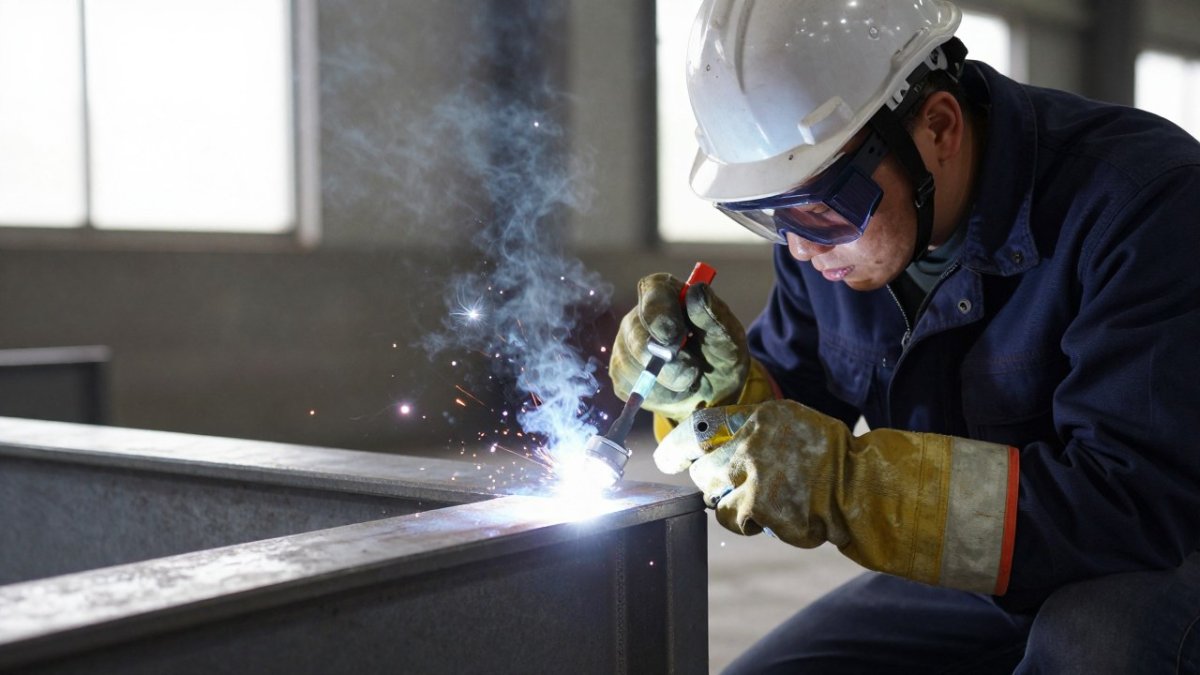
Step 1: Define the acceptance criteria before work begins. For structural steel, common acceptance criteria come from AWS D1.1 or AISC specifications (AWS D1.1/D1.1M:2025-AMD1: Structural Welding Code - Steel). Write these criteria into the project plan so the welder and inspector work from the same standard.
Step 2: Perform visual inspection on every weld. Visual inspection is the first and most common check. For a step-by-step guide to visual inspection, testing methods and acceptance criteria, see the verification resource. An inspector looks for uniform bead shape, full throat coverage, and the absence of surface cracks, undercut, porosity, and spatter. Visual inspection is sufficient for non-critical cosmetic welds, such as decorative gate scrollwork or railing infill panels not carrying primary load.
Step 3: Escalate to nondestructive testing based on risk. Visual checks cannot see inside a joint. For critical structural connections, teams often add ultrasonic testing (UT) or magnetic particle inspection (MT). A practical risk-based approach looks like this:
- Trailers and mobile equipment: Dynamic loads and vibration make fatigue cracking a concern. Magnetic particle inspection on hitch assemblies and axle welds helps catch surface-breaking defects that visual inspection misses.
- Structural steel erection: Moment connections and column splices in light structural steel often warrant ultrasonic testing to verify full penetration welds. AWS D1.1 provides acceptance criteria for UT.
- Pressure equipment and tanks: Radiographic testing (RT) or ultrasonic testing is common where leaks or rupture carry high consequence. ASME Boiler and Pressure Vessel Code governs acceptance.
- Production parts and repeat fabrication: First-article inspection plus periodic sampling balances cost and confidence. Destructive testing on coupons from the same lot verifies procedure compliance without testing every part.
Step 4: Document the results and close out findings. Record the inspection method, the acceptance criteria applied, the results, and any corrective actions. This record supports closeout and future maintenance decisions.
Watch out: a weld that looks clean on the surface can still hide internal lack of fusion. Relying on appearance alone is a common and costly mistake on structural work, and it is the reason risk-based escalation matters more than a single visual pass.
Common Welding Defects and Remedies
Most defects are predictable and preventable. Knowing their causes makes them easier to avoid.
| Defect | Common Cause | Remedy |
|---|---|---|
| Porosity | Dirty surfaces, moisture, gas shielding loss | Clean thoroughly, dry filler, check gas flow |
| Undercut | Excess amperage or travel speed | Lower heat, slow travel, adjust angle |
| Slag inclusion | Poor cleaning between passes | Remove slag fully before each pass |
| Lack of fusion | Low heat, poor fit-up | Increase heat, correct joint geometry |
| Cracking | Rapid cooling, high restraint, wrong filler | Preheat as needed, choose compatible filler |
Remedies usually mean grinding out the defect and rewelding it correctly. Rewelding without finding the root cause tends to repeat the same failure.
Welding Process Selection for Structural Steel, Railings and Gates
Different jobs call for different processes. Shielded metal arc welding (SMAW) handles field repairs and thick structural steel well. Gas metal arc welding (GMAW) offers speed for production runs and cleaner appearance on railings. Gas tungsten arc welding (GTAW), or TIG, delivers precise, clean welds on decorative iron gates and thin stainless components.
Matching Process to Material and Site Conditions
The site matters as much as the steel. Wind, rain and confined spaces can disrupt shielding gas, so outdoor mobile welding often favors processes less sensitive to drafts. Ask your welding contractor which process suits your material thickness, surface condition and exposure before work begins.
Welding Best Practices: Preparation, Fit-Up and Process Control
Good results come from a repeatable process. Start with a joint plan that defines the material, joint type, filler and inspection points. Then prepare the surfaces, verify fit-up and monitor the work as it progresses.
Practical steps that protect weld integrity:
- Confirm base metal type and thickness.
- Grind joints to bright metal and remove contaminants.
- Check alignment and gap before tacking.
- Set amperage, voltage and gas flow to the procedure.
- Control interpass temperature on thick sections.
- Inspect each pass and the finished joint.
Documentation, Welder Qualification and Material Traceability
Quality work leaves a paper trail, and that paper trail starts with qualified people and proven procedures. Most practitioners find that repeatable weld integrity depends less on individual skill alone and more on a system that documents what was done and who approved it.
Welder qualification. Ask for proof that welders are qualified for the process and position they are using. Under AWS D1.1, welders are tested to a specific process, position, and thickness range. A welder qualified for flat-position gas metal arc welding on thin gauge is not automatically qualified for vertical-up shielded metal arc welding on thick structural steel. To check these credentials, use a vetting checklist for commercial welding contractors. Qualification records show that a welder has demonstrated the skill to produce sound welds under a specified procedure.
Welding procedure specifications and procedure qualification records. A welding procedure specification (WPS) defines the material, joint design, filler metal, preheat, interpass temperature, and process parameters. A procedure qualification record (PQR) documents the test that proved the WPS produces sound welds. Together, the WPS and PQR give the contractor and the inspector a written standard to check against. Without them, process control depends on memory and habit.
Material traceability. Mill certifications tie the steel to its chemistry and strength. On structural and public projects, this matters because the specified grade, such as ASTM A992 for wide-flange shapes or ASTM A36 for plates and angles, carries minimum yield and tensile requirements. If a question arises later, mill certs make it easier to verify compliance and resolve disputes.
Records to retain. A practical documentation package includes:
- Welder qualification records and current certification dates
- WPS and PQR for each process and material combination used
- Mill certifications for base metal and filler metal
- Inspection reports with acceptance criteria and results
- Nondestructive testing reports where applicable
- Corrective-action records for any defects found and repaired
Who is qualified to approve work. On code-governed projects, the inspector or special inspector should hold the credentials the code requires. AWS Certified Welding Inspector (CWI) credentials are common for structural steel inspection. The authority having jurisdiction may also require special inspection for certain connections. Confirm who signs off before work begins, not after.
Watch out: a common failure pattern is a contractor who can produce a WPS but cannot produce the PQR that supports it. Ask for both, and confirm the welder's qualification matches the process and position actually used on your job.
Booking Reliable Welding for Your Silver Spring Project
Whether you need a railing replaced, an iron gate fabricated or structural steel erected, the right contractor protects both safety and schedule. Patriot Iron Work provides custom fabrication, mobile welding for on-site repairs, and light structural steel erection across Silver Spring, Montgomery County and the DMV. Get a free quote for your project, or find mobile welding service in Silver Spring if your steel cannot be moved to a shop.
Frequently Asked Questions
How can I tell if a weld is sound?
A sound weld shows even bead width, consistent ripple pattern, complete fusion at the edges and no visible cracks, undercut, porosity or heavy spatter. Visual inspection is a useful first step, but it cannot confirm internal fusion or penetration. For structural or load-bearing work, ask the welding contractor how their welds are verified, including whether inspection follows a documented procedure and whether the welders hold current qualifications for the process being used. Contact Patriot Iron Work for a quote and project review.
What causes most welding defects?
Most defects trace back to a few causes: dirty or oxidized base metal, incorrect amperage or travel speed, poor joint fit-up, wrong electrode for the material, and insufficient shielding gas coverage in windy or outdoor conditions. Porosity often signals contamination or gas problems, while undercut usually points to excessive heat input or travel speed. Remedies start with proper surface cleaning, correct joint preparation and dialed-in process settings, then verification of each pass before moving on.
Does mobile welding hold up for structural repairs?
Field welding can produce structural-quality results when the work is planned properly. The key factors are controlling the environment (wind, moisture and temperature affect shielding), preparing the joint thoroughly, and documenting the procedure used. Ask any provider how they manage on-site conditions and whether they document their procedures for field repairs.