 blog
5 Costs That Decide If Custom Metal Fabrication Pays Off
Last Updated: November 2, 2026
Quick Summary
Custom metal fabrication is usually worth it for a startup when the parts are specific, repeat often, or cost more to modify from stock. The decision rests on total cost, including rework and delays, not on the unit price of one part.
- Custom work tends to pay off when a part is not available in the size, grade, or shape you need.
- Ordering custom parts without clear drawings or measurements often leads to a second order.
- Break-even analysis shows the quantity where custom parts beat stock parts plus modification labor.
- Startup shop costs are reported at $20,000 to $60,000, depending on equipment and space.
- Confirm dimensions before approving a quote to avoid costly rework.
Table of Contents
- When Custom Metal Fabrication Makes Financial Sense for a Startup
- Custom Metal Fabrication vs. Off-the-Shelf Parts: A Cost Comparison
- Startup Costs: Equipment, Space, Labor, and Capital
- The Metal Fabrication Prototype Process and What It Costs to Validate a Design
- Small-Batch Metal Fabrication: Cash Flow, Runway, and Risk
- Custom Metal Fabrication Project Planning: Reducing Risk Before You Order
- Deciding Your Next Step: Build, Buy, or Outsource Your First Custom Parts
- Frequently Asked Questions
When Custom Metal Fabrication Makes Financial Sense for a Startup
Custom metal fabrication is worth the investment for a startup when the parts you need are specific, repeatable, and hard to buy off the shelf. The decision usually turns on the total cost of the work, not on the sticker price of a single part.
Starting a small metal fabrication shop is a serious commitment. Jim.com reports startup costs of $20,000 to $60,000 for a small shop, though the exact figure depends on equipment and space Jim.com guide to starting a metal fabrication business. Most startups will not buy that equipment on day one. They will hire a shop like ours instead.
Custom work tends to make the most sense when:
- The part does not exist in a catalog in the size, grade, or shape you need
- You order the same custom piece again and again
- A delay costs you more than the fabrication itself
- The part must match an existing structure, such as a railing, gate, or steel frame
Custom Metal Fabrication vs. Off-the-Shelf Parts: A Cost Comparison
Off-the-shelf parts look cheaper because the unit price is lower. The real comparison includes modification time, fit problems, and the cost of working around a part that almost fits.
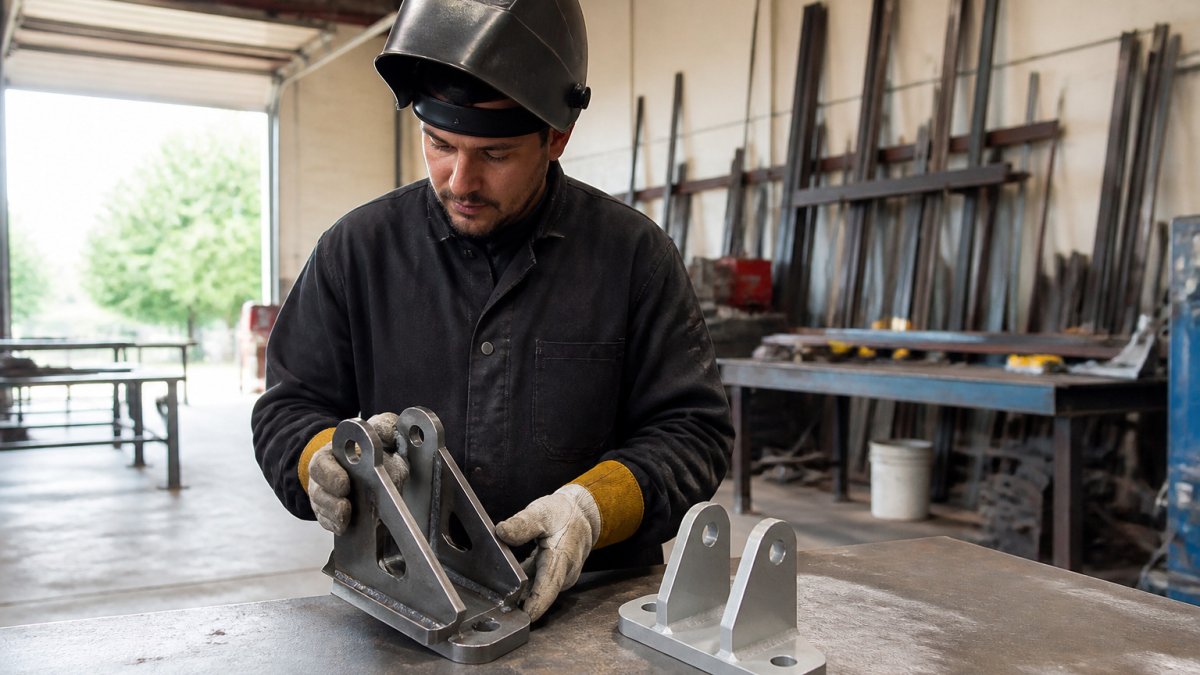
A stock bracket that needs cutting, drilling, and welding to fit can end up costing more than a part made to spec, once modification time is counted.
Watch out: Ordering custom parts without a clear drawing or measurement set usually leads to a second order. Confirm dimensions before you approve a quote.
Break-Even Analysis: Finding the Volume Where Custom Pays Off
Break-even tells you how many units you need before a custom approach beats buying stock parts. To estimate it, compare the total custom cost per unit against the stock price plus modification cost per unit, then find where the two lines cross.
- Add up the per-unit custom price, including delivery
- Add the stock unit price plus any cutting, welding, or fit-up labor
- Find the quantity where the custom price drops below the stock total
- Compare that quantity to your realistic first-year order volume
If your projected volume never reaches that point, a stock part with minor modifications is usually the better choice.
Startup Costs: Equipment, Space, Labor, and Capital
Running your own fabrication capability is not one purchase; it is a stack of recurring and one-time costs that only make sense at a certain utilization. The useful way to evaluate it is a total-cost-of-ownership (TCO) model that compares owning against outsourcing the same work.
Build the model in five lines:
- Equipment (one-time and recurring): Welders, plasma or laser cutting, press brake, saws, drill presses, clamps, fixtures, and material handling. Add installation, power drops, ventilation, and fume extraction. Then add maintenance, consumables (wire, gas, tips, discs), calibration, and replacement reserves.
- Facility: Rent or mortgage, utilities (welding power draw is significant), compressed air, lighting, fire suppression, and code-required egress and ventilation. A shop also needs laydown space for steel stock, which is floor area that produces nothing.
- Labor: Skilled welders and fitters are the hardest line to forecast. Budget for recruiting, onboarding, certification where the work requires it, and retention. A single qualified welder leaving can idle a cell for weeks.
- Working capital: Steel, hardware, and finish costs are paid before the customer pays you. Add deposits, progress payments, and retainage if you take commercial work.
- Overhead and risk: Insurance, permits, inspections, quality documentation, and downtime reserves.
Then compare that TCO against the outsourced alternative: the per-part price from a fabricator, plus freight, plus your internal handling and inspection time. Divide the annual ownership TCO by the number of parts you actually expect to make and you get an effective in-house cost per part.
A common pattern is that startups overestimate first-year volume and underestimate setup, consumables, and rework. Model a pessimistic case first. If ownership still wins at low utilization, it is a strong signal; if it only wins at optimistic volume, outsource and revisit later.
For many early-stage companies, partnering with an established shop for early projects can keep capital free for other priorities while demand becomes clearer.
The main cost lines for running an in-house fabrication capability are summarized below, so you can see where the money goes.
| Cost line | What it covers | Planning note |
|---|---|---|
| Equipment | Welders, cutting, press brake, saws, fixtures | Add maintenance, consumables and replacement reserves |
| Facility | Rent, utilities, ventilation, laydown space | Welding power draw is significant |
| Labor | Skilled welders and fitters | Hardest line to forecast; a single departure can idle a cell |
| Working capital | Steel, hardware and finish paid before customer pays | Add deposits and progress payments where possible |
| Overhead and risk | Insurance, permits, inspections, downtime | Keep a reserve for downtime and rework |
The Metal Fabrication Prototype Process and What It Costs to Validate a Design
A prototype lets you test fit, strength, and appearance before committing to a full run. For on-site validation or field repairs, mobile welding services can bring the work to your location. It costs more per piece than production work, but it can prevent expensive mistakes.
A typical prototype process includes:
- Share drawings or measurements with the shop
- Review material choice and finish options
- Fabricate and test a single sample
- Adjust the design based on the sample
- Approve the final production order
Small-Batch Metal Fabrication: Cash Flow, Runway, and Risk
Small batches create a cash conversion problem: you pay for steel, labor, and finish before the customer pays you. For a startup, the question is not just whether the part is worth making, but whether your runway can absorb the gap between cash out and cash in.
Map the cycle explicitly:
- Quote and deposit: Ask for a deposit on custom work, especially first orders and anything with custom material or finish. A deposit converts part of your risk into the customer's commitment.
- Material purchase: Steel and hardware are often paid on delivery or net-short terms. This is the first cash out.
- Fabrication labor: Payroll runs on a fixed schedule regardless of when the customer pays.
- Delivery and invoice: Invoice on delivery or milestone, not on installation completion, when possible.
- Collection: Track days sales outstanding (DSO). Net-30 is common; net-60 and retainage appear on commercial and construction-adjacent work.
Your cash gap is roughly the material and labor cost multiplied by the days between paying for inputs and collecting from the customer, divided by 365. A startup with a long DSO and no deposits is effectively financing its customers.
Runway implications:
- Capex compresses runway immediately. Equipment, installation, and facility buildout are cash out on day one, before any revenue. Model how many months of runway that consumes.
- Working capital grows with volume. More orders mean more steel and payroll in flight. A growing shop can be profitable on paper and still run out of cash.
- Rework and change orders are cash leaks. They consume labor and material without adding revenue, and they delay collection.
Risk controls that protect runway:
- Written specifications and approved drawings before material is ordered
- Deposits and progress payments tied to milestones
- A reserve for rework, delays, and specification changes
- Insurance and safety compliance for shop and job-site work
- A simple job-costing sheet per order so you can see margin before the invoice goes out
A practical rule: if a single order's cash gap would consume more than a small fraction of your available cash, either restructure the terms or outsource that job to a partner who can carry the material and labor float. Protecting runway is worth more to a startup than capturing every margin point.
Custom Metal Fabrication Project Planning: Reducing Risk Before You Order
Good planning cuts cost. Before you order, define the load requirements, finish, tolerances, and install conditions. Share all of it with your fabricator at the start.
Clear specifications reduce change orders, which are one of the biggest sources of cost overrun. You can also learn ways to reduce custom metal fabrication costs before you commit to an order.
Deciding Your Next Step: Build, Buy, or Outsource Your First Custom Parts
For most startups, the right next step is to outsource your first custom parts. You learn what you need, test your designs, and avoid heavy equipment costs until volume justifies them.
If you need a reliable partner, start by finding reliable metal fabricators for small projects and compare their process, timelines, and communication. An industrial metal fabrication services buyer's guide can also help you scope the work.
When you are ready to move forward, Patriot Iron Work offers custom fabrication, welding, steel railings, iron gates, and light structural steel erection across Silver Spring, Montgomery County, and the DMV. Request a free quote to talk through your project, timeline, and budget.
Frequently Asked Questions
Is custom metal fabrication worth it for a startup?
Custom fabrication is usually worth it when the part is specific, repeats often, or is costly to modify from stock parts. Compare total cost, including rework, before deciding.
How much does it cost to start a metal fabrication shop?
Jim.com reports $20,000 to $60,000 for a small shop, but actual costs depend on equipment, space, and labor. Pricing for custom work depends on quantity, materials, and delivery; request a quote for current pricing.
Should a startup buy equipment or outsource fabrication?
Most startups outsource early work to keep capital flexible. Consider buying equipment only when order volume is steady enough to keep it busy.
Frequently Asked Questions
Is custom metal fabrication worth it for a startup?
It can be, but only when the part is specific to your product and the volume justifies the cost. Startups with a standard part available off the shelf usually save money by buying it. Custom work tends to pay off when no catalog part fits the design, when the part is central to your product, or when the cost of a poor fit is high. Compare the total cost of each path, including design revisions, lead time, and the cash tied up in inventory, before committing to a custom run.
When should a startup choose custom metal parts over off-the-shelf components?
Choose custom parts when off-the-shelf options cannot meet your dimensions, load requirements, or finish, or when a stock part forces design compromises that hurt your product. If a catalog part works within acceptable tolerances at a lower unit cost, buy it. Custom fabrication also makes sense when a part is a differentiator for your product and you need control over material, geometry, and quality.
What should a startup provide to a metal fabricator?
Provide a complete drawing or CAD file with dimensions, tolerances, material specification, finish requirements, and quantity. State the intended load or use environment so the fabricator can recommend an appropriate material and joining method. Include any applicable standards, your target delivery date, and whether you expect design revisions. Clear inputs reduce quoting errors, rework, and delays.
Can a startup use a local fabricator for prototypes and small production runs?
Yes. Local shops are often well suited to prototypes and small-batch work because they can iterate quickly and communicate directly about design changes. Ask about minimum order quantities, how they handle revisions, and whether they can scale from prototype to production. Patriot Iron Work offers custom fabrication and welding for projects in Silver Spring, Montgomery County, and the DMV; contact the company for current pricing and a quote based on your quantities and schedule.