 Ultimate guide
7 Benefits of Custom Metal Fabrication for Commercial Buildings
Last Updated: October 26, 2026
Quick Summary
Custom metal fabrication lets commercial building owners specify exact dimensions, materials, and finishes instead of adapting catalog parts, delivering precision-engineered components that perform as designed and reduce callbacks and warranty claims.
- Precision in custom metal fabrication requires shop drawings, engineer approval, CNC cutting, welding fixtures, and dimensional inspection before delivery.
- Material selection directly impacts durability; carbon steel, stainless steel, and aluminum each suit different environmental exposures and maintenance requirements.
- Custom steel railings and gates meet code requirements while achieving the aesthetic your building demands without compromising on strength or character.
- Mobile welding brings fabrication expertise on-site for equipment repairs, structural modifications, and emergency fixes without transporting components off-site.
- Light structural steel fabrication and erection accelerates project delivery by producing components off-site while other phases proceed, then assembling quickly on arrival.
Table of Contents
- Why Custom Metal Fabrication Matters for Commercial Buildings
- Precision and Dimensional Accuracy in Custom Metal Fabrication
- Design Flexibility and Complex Geometries with Custom Steel Fabrication
- Durability and Long-Term Structural Performance
- Custom Commercial Steel Railings and Gates
- Mobile Welding for Commercial Properties and On-Site Installation
- Light Structural Steel Fabrication and Erection for Faster Project Delivery
- Durability and Long-Term Structural Performance
- Getting Your Custom Metal Fabrication Project Started
- Frequently Asked Questions
Why Custom Metal Fabrication Matters for Commercial Buildings
Custom metal fabrication lets architects and contractors specify exact dimensions, materials, and finishes instead of adapting catalog parts, critical when buildings demand non-standard geometries, specialized load-bearing capacity, or integration with existing structures.
The advantage goes beyond aesthetics: you control material grade, weld specifications, finish quality, and structural performance, no compromising on load ratings or corrosion resistance, no waiting on inventory.
Learn more about the full scope of services by reviewing industrial metal fabrication services to understand how custom metal fabrication applies to your commercial building project.
Precision and Dimensional Accuracy in Custom Metal Fabrication
A structural engineer's load, material, and dimensional calculations are only valid if fabricated components match the design intent. Parts within tight tolerances perform as engineered; drifting tolerances make performance unpredictable.
Precision also speeds installation. Components that fit exactly eliminate hours of grinding, shimming, and forcing parts into place, saving labor and keeping projects on schedule.
For developers and facilities managers, precision in custom metal fabrication also reduces callbacks and warranty claims: exact-spec railings won't shift or develop gaps, and repairs matched to original dimensions maintain building integrity.
How Precision Is Achieved in the Shop
Precision comes from a documented workflow: site measurements and field verification, shop drawings for engineer review and approval, then material selection, cutting, fit-up, welding, finishing, and dimensional inspection before delivery.
Key mechanisms that protect dimensional accuracy include:
- Shop drawings and approval cycles. Fabricators translate architectural and structural drawings into fabrication-level shop drawings showing every connection, weld symbol, and dimension. Engineers review and stamp these before fabrication begins, catching conflicts early.
- CNC cutting and drilling. Computer-controlled plasma, laser, or waterjet cutting and CNC drilling produce repeatable hole patterns and edge profiles. This matters for bolted connections where misaligned holes force field modifications.
- Jigs and fixtures. Welding fixtures hold components in alignment during fit-up and welding, controlling distortion and shrinkage that would otherwise pull dimensions out of tolerance.
Precision, Codes, and Engineering Compliance
Precision is also a compliance issue: fabricated geometry must match what the engineer of record designed. Common reference points include:
- Structural welding: AWS D1.1 Structural Welding Code, Steel governs welding requirements for steel structures, including procedure qualification and inspection (AWS D1.1/D1.1M:2025-AMD1: Structural Welding Code - Steel).
- Steel construction: AISC 360 Specification for Structural Steel Buildings and AISC 303 Code of Standard Practice address fabrication and erection tolerances and responsibilities.
- Guardrails and handrails: The International Building Code (IBC) sets guard height, loading, and opening limitations, while ICC A117.1 Accessible and Usable Buildings and Facilities addresses handrail and guard accessibility details.
Working from approved shop drawings and inspecting against them links precision directly to code compliance.
Precision in Commercial Building Applications
- Curtain wall and façade support connections. Embed plates and anchor locations must align with the structural frame within tolerance so façade systems install without field modification.
- Stair and railing systems. Stringer dimensions, tread locations, and rail heights must match the design and accessibility requirements; small errors compound across a flight.
- Rooftop equipment supports. Frames that carry mechanical units must match curb dimensions and roof framing so loads transfer as engineered.
What to Ask a Fabricator About Precision
Before awarding a commercial fabrication scope, ask:
- Will shop drawings be produced and reviewed by the engineer of record before fabrication?
- What cutting and drilling methods are used, and how are hole patterns controlled?
- How is welding distortion managed, fixtures, sequencing, or both?
- What dimensional inspection is performed, and what records are provided?
- How are field measurements verified before fabrication begins?
Precision in custom metal fabrication is a chain, field measurement, shop drawings, engineer approval, controlled fabrication, inspection, delivery. When it holds, the building performs as designed and callbacks drop.
Design Flexibility and Complex Geometries with Custom Steel Fabrication
Custom steel fabrication handles geometries standard products cannot, curved railings, angled supports, non-rectangular frames, integrated mechanical systems, so architects design what the building needs rather than constraining designs to available inventory.
Flexibility extends to material selection: coastal buildings need salt-air corrosion resistance, industrial facilities may need wear-resistant surfaces, government buildings may require specific certifications. Custom steel fabrication lets you choose the material that performs best for your environment.
Durability and Long-Term Structural Performance
Material selection directly impacts how long fabricated components perform. Steel offers strength and durability when properly specified and maintained. Aluminum provides corrosion resistance in certain environments.
The choice between materials affects lifecycle costs significantly. A material that resists your building's specific environmental challenges requires less maintenance and lasts longer.
Understand the durability trade-offs by comparing steel versus aluminum fabrication for durability to select the material that provides the best long-term performance for your commercial building's specific conditions.
Material Selection for Commercial Building Conditions
Durability starts with matching material to exposure, interior spaces, exterior façades, parking structures, loading docks, rooftop equipment, and coastal or deicing-salt conditions each change which material and finish perform best.
Carbon steel is the workhorse for structural and architectural fabrication, offering a high strength-to-cost ratio and ready weldability.
Stainless steel resists corrosion through a passive chromium-oxide layer.
Aluminum offers a high strength-to-weight ratio and natural corrosion resistance through its oxide layer, and is common for curtain wall framing, canopies, and lighter architectural features.
Corrosion Exposure and Detailing
Durability is as much about detailing as material. Common failure points:
- Water traps. Ledges, open sections, and crevices that hold moisture accelerate corrosion. Detailing for drainage and avoiding pockets extends service life.
- Dissimilar metals. Contact between dissimilar metals in the presence of moisture can cause galvanic corrosion. Isolation washers, coatings, or compatible material selection prevent it.
- Coating damage during handling and installation. Touch-up procedures protect coating integrity after fabrication and erection.
Finish Selection and Maintenance Implications
Finish choice drives both appearance and maintenance burden:
| Finish | Typical use | Maintenance implication |
|---|---|---|
| Hot-dip galvanizing (ASTM A123) | Structural steel, exterior railings, embedments | Long service life in many environments; may need coating for appearance or severe exposure |
| Shop-applied liquid coatings | Architectural steel, interior and exterior | Color and gloss options; periodic inspection and touch-up recommended |
| Powder coating | Architectural features, railings, gates | Durable finish; requires proper surface prep and may need touch-up at damage points |
| Stainless steel (mill or brushed) | Handrails, guards, exterior features | Minimal maintenance; cleaning to preserve appearance |
| Anodized aluminum | Curtain wall, canopies, trim | Good corrosion resistance; color and finish options |
Interior components typically need little beyond cleaning; exterior components exposed to weather, deicing salts, or coastal air need periodic inspection and touch-up. Build these into routine maintenance rather than waiting for visible corrosion.
Lifecycle Cost Considerations
A lower upfront material cost can be outweighed by maintenance, repair, and replacement over a building's service life. Compare:
- Initial material and fabrication cost.
- Coating or finish cost and expected service life.
- Routine inspection and maintenance labor.
More corrosion-resistant material or a more durable coating system usually raises upfront cost but reduces maintenance and replacement over time; the right balance depends on exposure, expected service life, and the owner's maintenance capacity.
For aging commercial buildings, custom metal fabrication lets structural repairs match or exceed original performance, a 40-year-old building can get repairs engineered for another 40 years of service.
Custom Commercial Steel Railings and Gates
Steel railings and gates serve functional and aesthetic roles: railings must meet code for height, strength, and baluster spacing, while gates must secure the premises without compromising visual character.
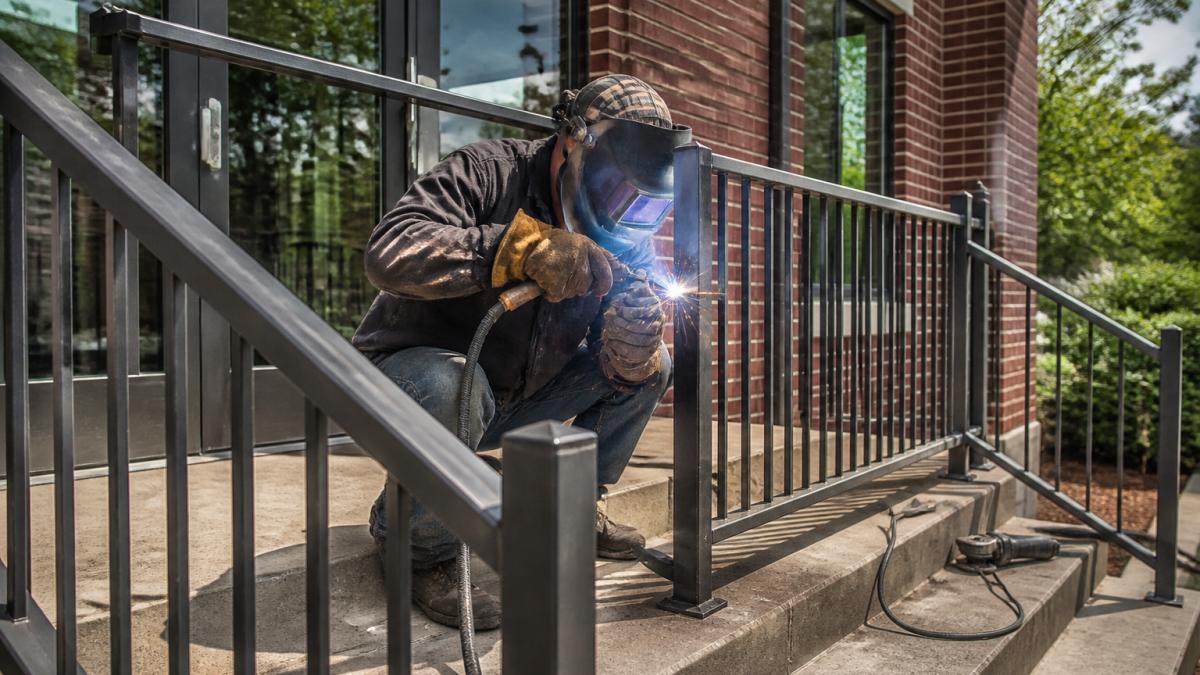
The quality difference shows over time: properly fabricated railings won't develop loose connections or visible corrosion, and well-designed gates won't sag, bind, or demand constant maintenance.
Mobile Welding for Commercial Properties and On-Site Installation
Not every commercial project fits a fabrication shop. Mobile welding brings fabrication expertise directly to your property, on your schedule.
On-site welding also improves quality control: you observe the work, verify material quality, and confirm the fabricator understands your building's conditions in real time rather than relying on descriptions or photos.
Learn more about selecting qualified welding contractors for on-site work by reviewing how to hire reliable commercial welding contractors to ensure your mobile welding project meets your timeline and quality requirements.
Light Structural Steel Fabrication and Erection for Faster Project Delivery
Commercial construction runs on tight timelines, and delays cascade. Light structural steel fabrication and erection can accelerate delivery when planned correctly.
Exact dimensions and pre-drilled connection points mean crews install and verify alignment instead of fitting, drilling, or adjusting, efficiency that keeps the project moving.
For developers, faster delivery reduces carrying costs and allows earlier revenue; for facilities managers overseeing renovations, it minimizes operational disruption.
Determine whether certified steel erectors are necessary for your project by reviewing whether hiring a certified steel erector is worth it to understand the safety, code compliance, and structural integrity benefits for your light structural steel erection needs.
Durability and Long-Term Structural Performance
Material selection directly impacts how long fabricated components perform. Steel offers strength and durability when properly specified and maintained. Aluminum provides corrosion resistance in certain environments.
The choice between materials affects lifecycle costs significantly. A material that resists your building's specific environmental challenges requires less maintenance and lasts longer.
Understand the durability trade-offs by comparing steel versus aluminum fabrication for durability to select the material that provides the best long-term performance for your commercial building's specific conditions.
Getting Your Custom Metal Fabrication Project Started
Starting a custom metal fabrication project requires clear communication about requirements, realistic timelines, and budget.
Reduce project costs without compromising quality by exploring 7 ways to reduce custom metal fabrication costs to identify opportunities for efficiency improvements during your project planning phase.
Document what your project requires, architectural drawings, engineering specifications, environmental conditions, installation constraints, and timeline.
The fabricator should provide a detailed quote breaking down material, fabrication labor, finishing, and delivery.
Quality fabrication requires proper planning, clear specifications, and experienced fabricators who understand commercial building requirements.
Custom metal fabrication solves problems that standard components cannot address.
Frequently Asked Questions
What is custom metal fabrication and how does it differ from standard components?
Custom metal fabrication involves designing and building metal components to exact specifications for your project, rather than using off-the-shelf products. This approach allows engineers to match your building's unique requirements, load conditions, and architectural vision. Standard components often require design compromises or costly modifications on-site. Custom fabrication delivers precise fit, form, and function the first time, reducing waste and installation complexity.
How does mobile welding for commercial properties speed up project timelines?
Mobile welding brings fabrication expertise directly to your site, eliminating transport delays and allowing real-time coordination with your construction team. Field welding reduces lead times for components that must be fitted or modified on-site, and allows repairs or adjustments without shipping delays. This on-site capability is especially valuable for tight construction schedules or when structural modifications emerge during the build.
What makes custom steel railings and gates better than prefabricated options?
Custom steel railings and gates are engineered to match your building's exact dimensions, architectural style, and safety requirements. Prefabricated options often require costly modifications or compromises in appearance and function. Custom fabrication ensures proper fit around existing structures, compliance with building codes, and design continuity with your commercial property's overall aesthetic and structural integrity.
How do you ensure custom metal fabrication meets building codes and safety standards?
Professional fabricators design and build to meet all applicable building codes, including structural load requirements, safety railings, and material standards. The fabrication process includes dimensional verification, material testing, and inspection checkpoints. Engineering documentation and quality certifications accompany the finished components, giving you confidence that your custom metalwork will pass final inspections and perform reliably under specified load conditions.